Smooth Council Approvals
Avoid costly DA delays with accurate, compliant reports that satisfy council town planners.
Comprehensive, legally defensible AQF Level 5 arborist reports for council applications, insurance, and risk assessment.
Providing consulting arborist reports across Bargara, Bundaberg, and the Burnett coast.
When planning a new build, renovating near mature trees, managing neighbour tree disputes, or applying to Bundaberg Regional Council for tree clearing, a formal arborist report Bargara is essential. Our Level 5 arborists deliver thorough, evidence-based reports that meet all regulatory standards.
Bargara blocks often intersect sensitive coastal overlays, including the Sea turtle sensitive area overlay and Coastal protection overlay. Council requires rigorous arborist reporting to ensure development does not compromise remnant littoral vegetation or significant coastal pines.
Avoid costly DA delays with accurate, compliant reports that satisfy council town planners.
Receive defensible documentation establishing tree health and duty-of-care risk management.
Design driveways, foundations, and footings that protect significant trees while ensuring build integrity.
We review your site plans, architectural drawings, and council requirements for your Bargara site.
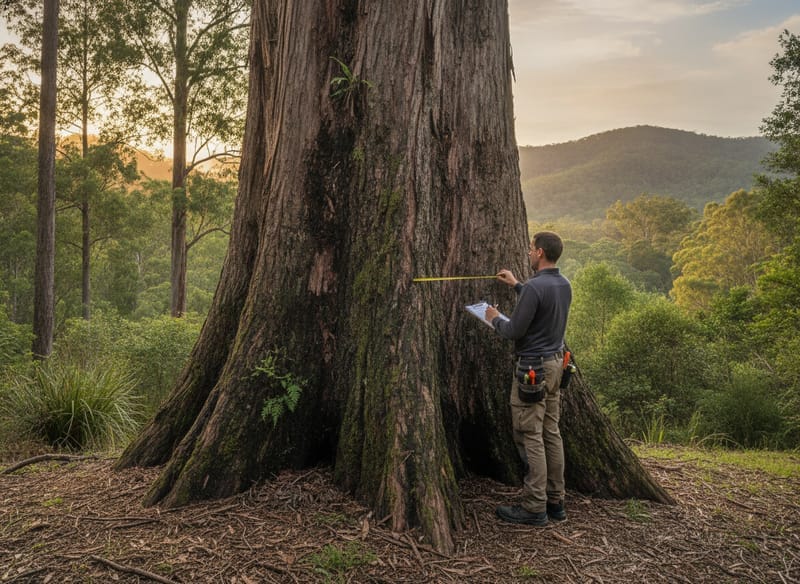
Our Level 5 arborist inspects trunk integrity, canopy health, root zones, and measures DBH (diameter at breast height).
We calculate TPZ/SRZ offsets and analyze building encroachments against AS4970 standards.
You receive a comprehensive, structured report with high-resolution photos, maps, and formal recommendations.
When you are planning a development, resolving a property dispute, or managing hazardous trees on the coast, a professional Arborist Report Bargara is your essential first step. Whether you are a homeowner, an acreage owner, a builder, or a property manager, navigating the specific planning schemes of the Bundaberg Regional Council requires accurate, formal documentation. Bargara is home to spectacular coastal landscapes, from forty-year-old residential gardens to towering Norfolk Island Pines and coastal She oaks exposed to constant wind shear.
Our team provides fully compliant, highly detailed reports prepared by an AQF Level 5 consulting arborist. We understand the unique challenges of Bargara's sandy soils, subtropical storm seasons, and strict local overlays. If you are building a new home, renovating near established canopy, or seeking permission to clear hazardous vegetation, our arborists deliver the authoritative assessments you need to satisfy council requirements, protect your assets, and ensure your project moves forward without costly delays.
One of the most common mistakes property owners and developers make is relying on under-qualified advice when dealing with local council overlays. Submitting a site assessment written by an uncertified tree lopper, or attempting a DIY risk assessment, will almost certainly result in a rejected application from the Bundaberg Regional Council. This wastes your money, stalls your construction timeline, and leaves you exposed to significant legal and financial liabilities if a protected tree is improperly managed or damaged.
The solution is partnering with our certified AQF Level 5 consulting arborists. We bring the required legal and technical authority to every project. Our team conducts meticulous Visual Tree Assessments (VTA) and calculates precise Tree Protection Zones (TPZ) and Structural Root Zones (SRZ) in strict accordance with Australian Standards. We know exactly what the council planners look for, especially when dealing with Bargara's Coastal protection overlay or the Sea turtle sensitive area overlay. By handling the complex diagnostics and paperwork correctly the first time, we bridge the gap between your development goals and environmental compliance, giving you complete peace of mind and a clear path forward for your build.
We deliver a full suite of formal tree assessments, entirely tailored to Bargara’s specific environmental overlays and the Bundaberg Regional Council Planning Scheme 2015. Every report is drafted by an AQF Level 5 arborist to ensure regulatory acceptance.
Required by the Bundaberg Regional Council for works near protected vegetation. We provide a comprehensive tree inventory, species identification, Trunk Diameter at Breast Height (DBH) measurements, and Safe Useful Life Expectancy (SULE) ratings. Our reports clearly outline retention values and provide the exact mitigation strategies planners need to approve your DA.
Essential for building sites to prevent root compaction and trunk damage during construction. We calculate and map out the Tree Protection Zone (TPZ) and Structural Root Zone (SRZ) for all retained trees. The plan specifies fencing requirements, mulch protection, root mapping, and supervised work zones tailored to Bargara's sandy coastal profiles.
Utilising industry-standard Visual Tree Assessment (VTA) principles, we document structural defects, canopy decline, and target zones (such as houses or pedestrian paths). This is critical for assessing post-flood root plate stability, salt burn damage, or branch failure risks ahead of Bundaberg's severe summer storm season.
When a tree falls within the Biodiversity areas overlay or Heritage and neighbourhood character overlay, you must prove it is dead, dying, or dangerous to gain removal approval. We provide the hard photographic evidence, disease diagnosis, and structural failure analysis required to legally justify the complete removal of the tree.
Our process is designed to be seamless, transparent, and entirely tailored to the specific needs of your site. Step one begins with a detailed initial consultation. We discuss your property, the specific goals of your project, and any known Bundaberg Regional Council overlays—such as the Bushfire hazard overlay or coastal restrictions—that might impact your plans. We determine exactly what type of Arborist Report Bargara requires for your specific situation, ensuring you do not pay for documentation you do not need. Step two is the comprehensive site inspection. Our AQF Level 5 consulting arborist visits your Bargara property to gather hard data. We measure trunk diameters (DBH), evaluate canopy vitality, identify precise local species like coastal Pandanus or Hoop Pine, and inspect for structural weaknesses using established VTA methodologies. We also map out the spatial relationship between the trees and your proposed construction footprints. Step three involves drafting the formal documentation. We compile all field data, photographic evidence, and SULE ratings into a council-ready PDF report. This includes precise TPZ/SRZ calculations and clear, actionable recommendations for retention or removal. Finally, step four is delivery and ongoing support. We provide your finalised Arborist Report Bargara ready for immediate submission to the council or your private certifier. If the council planners have any follow-up technical queries regarding our tree protection measures, our team remains fully available to clarify our findings and keep your project on schedule.
Every document we produce strictly adheres to AS4970 Protection of Trees on Development Sites and AS4373 Pruning of Amenity Trees. As fully insured, AQF Level 5 certified consulting arborists, our reports carry the exact professional weight demanded by the Bundaberg Regional Council and private certifiers. Whether you are navigating the strict Coastal protection overlay along the Bargara esplanade, managing lighting impacts under the Sea turtle sensitive area overlay near Mon Repos, or documenting hazards under the current state disaster clearing exemption (active until March 2027 following the 2026 floods), we ensure your project is entirely legally compliant and structurally safe.
Managing trees in Bargara requires deep local expertise. From the established forty-year-old gardens of coastal retirees to the towering Norfolk Island Pines that define the foreshore, a generic assessment simply will not suffice. Many properties in this coastal strip fall heavily under the Coastal protection overlay or the Sea turtle sensitive area overlay. This means that removing large canopy trees can trigger strict council assessment criteria to prevent light pollution from spilling onto the Mon Repos loggerhead turtle rookeries. Furthermore, our subtropical climate drives rapid canopy growth, while our fierce summer storm seasons and east coast lows heavily test the root stability of large backyard trees anchored in Bargara's sandy coastal soils. We factor all these local climatic drivers—including prevailing salt burn and wind shear—into our SULE ratings and risk assessments, ensuring your report accurately reflects the realities of living on the Bundaberg coast.
Once your report is approved by the council and your project begins, strict adherence to the documented Tree Protection Zones (TPZ) is non-negotiable. For development sites, you must ensure that protective fencing remains intact and that builders do not store materials or operate heavy machinery over the structural root zones of any retained trees. If your report mandates AS4373-compliant formative pruning or deadwooding to mitigate risks, our AQF Level 3 climbing arborists can execute the physical work exactly as specified. We recommend calling us back for an annual visual inspection of your large retained canopy trees, particularly after Bargara's intense summer storm season, to ensure they remain safe and structurally sound.
Arborist report pricing is based on the number of trees assessed, the complexity of development plans, and reporting requirements.
We provide clear, upfront fixed quotes for all consulting arborist reports.
Our consulting arborists supply reports across Bargara and the broader Bundaberg region.
Contact our consulting arborists for professional advice and development-ready reports.
Get a Free Quote