Smooth Council Approvals
Avoid costly DA delays by submitting comprehensive, council-compliant arborist documentation upfront.
AQF Level 5 consulting arborist assessments for council approvals, development, and risk management.
Consulting arborist reporting throughout Bundaberg North and the Burnett region
Whether you are submitting a Development Application to Bundaberg Regional Council, planning an extension on a character block, or managing a disputed boundary tree, an AQF Level 5 arborist report provides the legal and technical proof you need.
In Bundaberg North, properties bordering watercourses or containing remnant coastal scrub often trigger the Biodiversity areas overlay code under the Bundaberg Regional Council Planning Scheme 2015. Council requires formal AQF Level 5 reports before assessing clearing or building within these zones.
Avoid costly DA delays by submitting comprehensive, council-compliant arborist documentation upfront.
Know the exact health, structural integrity, and remaining life expectancy of your major trees.
Protect yourself against neighbour disputes and liability claims with independent, certified reports.
Our AQF Level 5 arborist conducts a comprehensive Visual Tree Assessment (VTA) of health and structure.
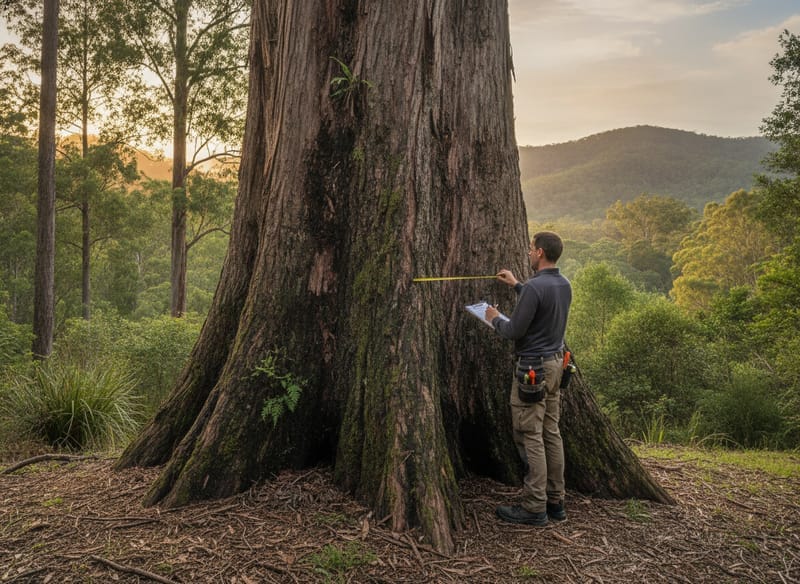
We measure trunk diameter (DBH), calculate TPZ/SRZ distances, and check council overlay mapping.
We draft a formal report detailing findings, risk scores, photos, retention strategies, and recommendations.
You receive a digital PDF report ready for submission to Bundaberg Regional Council, builders, or insurers.
As the senior arborists at Bundaberg Arborist, we know that managing significant trees along the Burnett River requires more than just a quick glance. Whether you are subdividing a block near the heritage overlays of the old city, developing new acreage, or dealing with compromised timber after the March 2026 floods, securing a professional Arborist Report Bundaberg North is the critical first step. Our AQF Level 5 consulting arborists provide the detailed, factual documentation that homeowners, builders, and developers need to move forward with absolute confidence. Navigating the Bundaberg Regional Council Planning Scheme 2015 can be a complex process, especially with strict overlays like the Biodiversity areas overlay or the Heritage and neighbourhood character overlay covering parts of Bundaberg North, Central, and South. An accurate, independent tree report cuts through the local red tape. We rigorously assess structural integrity, root zone health, and potential development impacts, delivering clear, actionable recommendations that satisfy council requirements and keep your residential or commercial site safe.
A common and costly mistake we see across the Bundaberg region is property owners or developers relying on under-qualified opinions or basic lopping quotes instead of a formal tree assessment. When a tree sits inside a mapped council overlay or close to a proposed building footprint, a handwritten note from a tree lopper will simply not pass muster. Bundaberg Regional Council strictly requires documentation prepared by an AQF Level 5 consulting arborist. Without it, your Development Application (DA) can face frustrating delays, expensive re-submissions, or you could even be fined for unlawful clearing.
We provide the definitive solution by delivering comprehensive, standard-compliant reporting. Our arborists ground every assessment in Australian Standards, specifically AS4970 Protection of Trees on Development Sites and AS4373 Pruning of Amenity Trees. We accurately map out Tree Protection Zones (TPZ) and Structural Root Zones (SRZ), detailing exactly how a mature Hoop Pine or Moreton Bay Fig can be retained without compromising your construction timeline.
For risk assessments, taking a DIY approach to a declining backyard Mango tree or a storm-battered Queensland Blue Gum is incredibly dangerous. We conduct systematic Visual Tree Assessments (VTA) to identify internal decay, weak unions, and target risks, giving you a legally robust document that justifies necessary removals or structural pruning.
Our AQF Level 5 consulting arborists produce detailed, site-specific documentation tailored to your exact residential or commercial project requirements.
We produce comprehensive tree inventories mapping species identification, Diameter at Breast Height (DBH), and Safe Useful Life Expectancy (SULE) ratings. This reporting is essential for navigating Bundaberg Regional Council overlays when building, extending, or sub-dividing.
We provide detailed specifications for protecting retained trees throughout the construction phase. Our team calculates and maps your Tree Protection Zones (TPZ) and Structural Root Zones (SRZ), outlining required fencing, mulch protection, root mapping, and supervised work zones.
Utilizing industry-standard Visual Tree Assessments, we evaluate the structural integrity and health of mature canopies. We document defects, target zones, and failure likelihood, providing crucial duty-of-care documentation for schools, property managers, and homeowners.
Formal documentation required when seeking council approval to remove a protected or significant tree. We detail the tree's deteriorating condition, irreversible structural faults, the lack of viable pruning alternatives under AS4373, and replanting recommendations.
Delivering a precise and legally sound arborist report requires a meticulous, structured approach. The process begins the moment you contact our team to discuss your specific needs—whether it is a pre-purchase tree inspection in Bundaberg North, a DA requirement for a new build, or a risk assessment for a heritage-listed Moreton Bay Fig.
First, we review your property against the Bundaberg Regional Council online mapping to identify any relevant overlays, such as the Bushfire hazard or Biodiversity areas. We then arrange an initial site consultation where our AQF Level 5 arborist visits your property to understand the exact scope of works and site constraints. We provide a transparent, fixed-price quote before any reporting begins.
Once approved, the detailed fieldwork commences. We conduct thorough on-site data collection, which includes species identification, precise DBH measurements, canopy mapping, and extensive photographic evidence. We perform Visual Tree Assessments to spot hidden decay, root upheaval, or structural weaknesses.
Finally, we head back to our office to compile the field data into a comprehensive, formal PDF document. We cross-reference our findings with AS4970 and AS4373 standards, formulate actionable recommendations, and deliver a finalized report ready for council submission, legal proceedings, or your peace of mind.
When producing an Arborist Report Bundaberg North, compliance and legal standing are our highest priorities. All our consulting reports are authored exclusively by AQF Level 5 Diploma-qualified arborists, which is the mandatory credential recognized and required by the Bundaberg Regional Council for development applications and overlay clearing.
Our methodologies strictly adhere to AS4970 Protection of Trees on Development Sites and AS4373 Pruning of Amenity Trees. Furthermore, we operate as a fully insured local business, holding comprehensive Public Liability, WorkCover, and Professional Indemnity insurance. This ensures that every risk assessment, removal justification, or tree protection plan we sign off on provides you with absolute legal, financial, and structural protection.
Bundaberg North presents a unique mix of heritage residential blocks, river flat vulnerabilities, and mature subtropical canopies. Properties positioned along the Burnett River often deal with alluvial soils and large, fast-growing species like Mango trees, Jacarandas, and Forest Red Gums that require careful management. Following the severe Burnett River flood of March 2026, many properties in Bundaberg North, Central, and South experienced significant inundation. This led to prolonged soil softening and compromised root systems across the urban canopy. While the state disaster clearing exemption runs until March 2027 for immediate hazards, securing formal reporting is still highly recommended for insurance claims, neighbor disputes, and complex retention decisions on flood-affected timber. Whether we are mapping a heritage street tree constraint under the Heritage and neighbourhood character overlay, or calculating tree protection zones for a new build on an old cane block, our reports are grounded in local reality. We deeply understand the subtropical Bundaberg climate and the specific structural behaviors of our local tree species.
Once you receive your finalized PDF arborist report from our team, the next step is implementation. For development and construction sites, this means strictly establishing the specified Tree Protection Zones (TPZ) with appropriate high-visibility fencing and signage before any heavy machinery arrives on site.
If the report recommends remedial pruning, weight reduction, or hazardous tree removal, our AQF Level 3 climbing arborists can execute the physical tree work exactly as specified, ensuring full compliance with AS4373. We strongly recommend keeping a digital copy of your report on file for future reference, and contacting us for a reassessment every 2 to 3 years for retained high-risk mature trees to ensure their ongoing structural safety.
Arborist report costs in Bundaberg North depend on the number of trees assessed, the complexity of development plans, and required overlay investigations.
We provide transparent, fixed quotes for all consulting arborist reports with clear delivery timeframes.
Our AQF Level 5 consulting arborists provide comprehensive reports across Bundaberg North and the entire region.
Get professional AQF Level 5 consulting arborist reports for council and construction.
Request a Report Quote